
A customer asks, “How much would this cost?”
It sounds like a pricing question. But underneath it are other questions: Do you understand what I need? What will I actually receive? Will there be surprises later?
For a service business, the first quote is an opportunity to answer all three.
A clear quote connects the price to the work. And that clarity starts with the conversation before the quote is prepared.
The same request can mean very different jobs
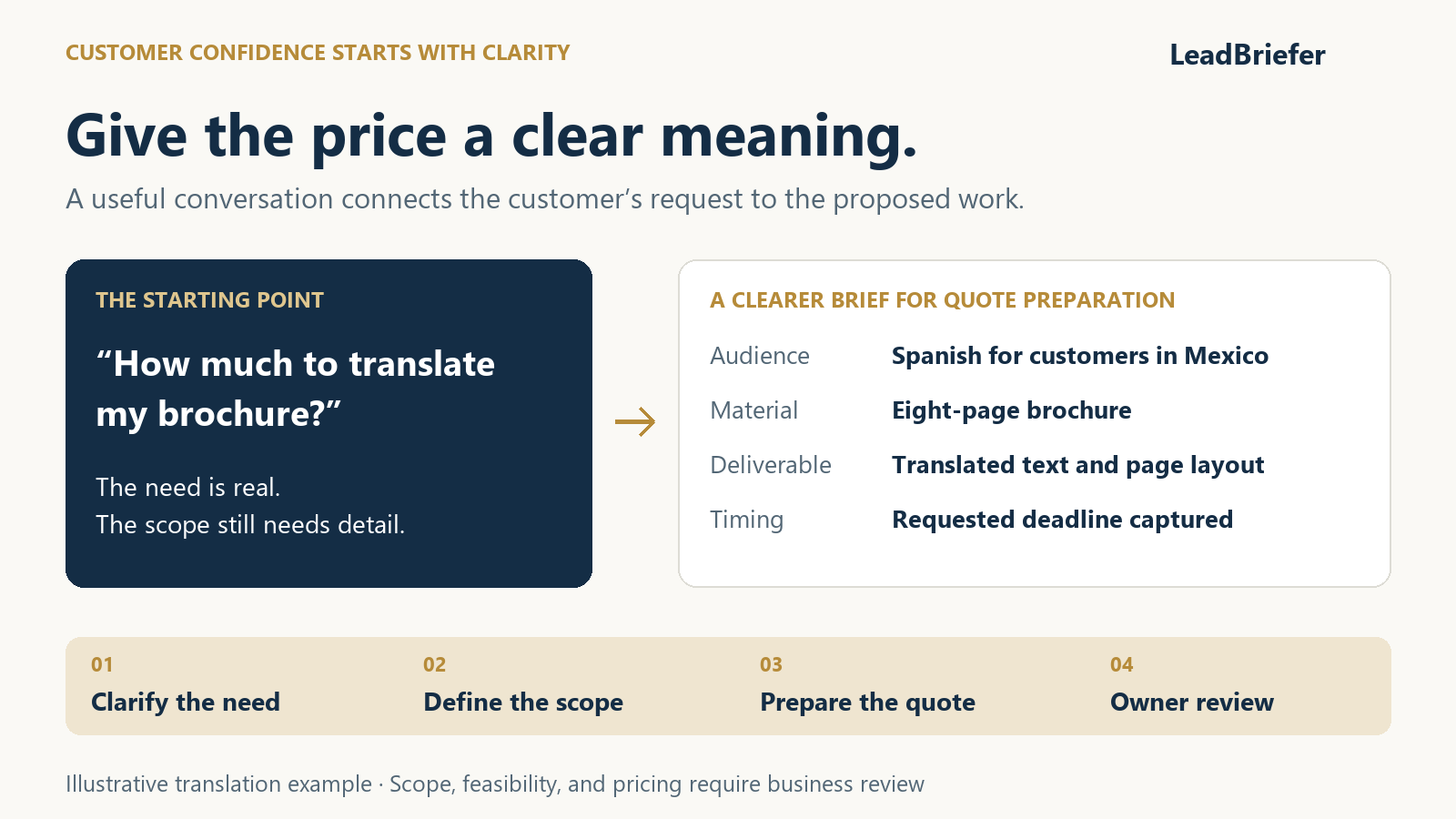
Consider a customer who contacts a translation business:
“I need a brochure translated into Spanish.”
That gives the business a starting point. Preparing a useful quote may also require knowing the document’s length, intended audience, deadline, and whether the customer needs translated text or a finished brochure with the layout preserved.
Without those details, the business and customer could picture different deliverables while believing they agree.
The same problem appears across service businesses:
- Mobile pet grooming: A request for “a grooming appointment” could mean a bath and brush or a fuller service, with the animal’s size and coat condition affecting the work.
- IT support: “Help setting up our computers” might involve two laptops or an entire office, with different needs for installation, data transfer, and ongoing support.
- Translation: A short document with a flexible deadline differs from a formatted brochure needed urgently.
These examples are illustrative, but the underlying challenge is familiar: a short inquiry rarely describes the whole job.
Help customers explain what they need
Customers should not have to understand your pricing model before contacting you. They may not know which details affect the scope or what terminology your industry uses.
A useful conversation helps them explain their situation in ordinary language.
For example, an IT support inquiry might begin:
Customer: “We’re moving into a new office and need our computers set up.”
A relevant follow-up could establish how many people need equipment configured. The answer may reveal another detail: some employees work remotely.
That changes what the business needs to understand before quoting.
The value comes from following the customer’s situation as it develops. Each answer helps establish what the job involves.
A clearer path to a quote:
Initial inquiry → Relevant follow-up → Understood scope → Draft quote → Owner review
Where LeadBriefer fits
LeadBriefer is being built to support this process.
The business provides information about its services, pricing, intake requirements, and the details needed to prepare a quote. LeadBriefer uses that context to determine relevant questions as the conversation develops.
The business owner does not need to script every question.
That distinction matters because customers arrive with different levels of knowledge and different needs. One person may already have a detailed brief. Another may need help explaining the request.
LeadBriefer’s role is to help develop the information needed for quote preparation, using the business’s context and pricing. The owner then reviews the result, makes adjustments, and approves it.
Make the price easier to understand
Once the scope is clearer, the quote can explain what the customer is paying for.
For the translation customer, that could mean identifying the documents, target language, agreed deliverables, and any formatting work included. For IT support, it could mean distinguishing initial setup from ongoing assistance.
The owner should also check assumptions and identify anything that still needs confirmation.
Some jobs require a call, inspection, or deeper discovery before a reliable price is possible. Recognizing that early is part of setting expectations well.
A professional first impression starts before delivery
Customers experience your business before you begin the paid work. They experience how you listen, what you clarify, and how clearly you explain the next step.
A thoughtful intake conversation can demonstrate care. A clear quote can give that conversation a concrete result.
Whether your service is delivered on-site, remotely, digitally, or through a combination of methods, the opportunity is the same: help the customer understand the proposed work before asking them to move forward.
LeadBriefer is being built to make that early conversation more useful—for the business preparing the quote and the customer deciding what to do next.