
Before a designer creates a website, someone has to establish which pages it needs. Before a photographer arrives with a camera, someone has to agree on coverage and deliverables. Before a cleaner starts a new job, someone has to understand the space and the service required.
That preparation is work. It begins with the customer’s first question and can stretch across messages, calls, clarifications, and a quote that still needs to be put together.
“How much would it cost?” sounds like a simple question. Answering it well can take considerably more effort.
What the research tells us about the work before the job
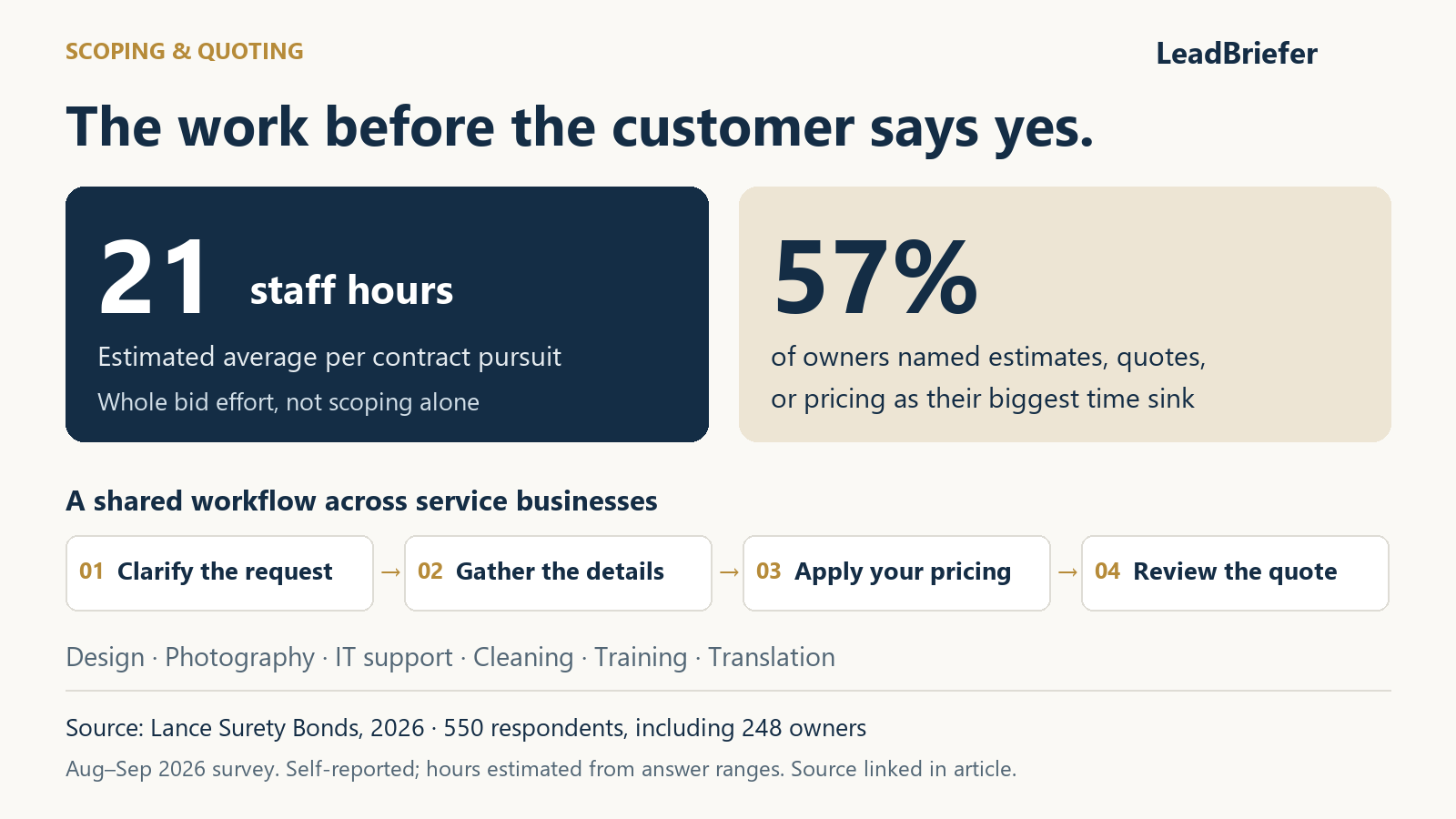
In a 2026 Lance Surety Bonds survey, respondents reported an estimated average of 21 staff hours spent pursuing a single contract. Among owners, 57% named preparing estimates, quotes, or pricing as their biggest time sink. Across respondents, 49% said pursuing contracts took time away from existing customers or other revenue-generating work.
The survey covered 550 people working at small businesses, including 248 owners, in August and September 2026. Its hours are estimates calculated from self-reported answer ranges. The 21-hour figure covers the whole contract pursuit, including activities beyond scoping and customer communication; it is not a universal time-per-quote benchmark.
A separate Jobber survey of 1,050 U.S. home service business owners, conducted in December 2025, found that 40% identified customer communication and 37% identified quoting among their most time-consuming daily tasks. Those are percentages of respondents, not percentages of the workday, and communication can include work after a job starts.
These studies measure different things. Together, they give a concrete reason to pay attention to preparation. Neither isolates a single average for pre-job scoping and back-and-forth across every service industry.
Small exchanges can become a substantial workload
The effort is often scattered:
A customer asks about a service. You ask for more detail. Their answer raises another question. They add something they forgot. You check the pricing, assemble the scope, and write the quote.
Each exchange may be short, but you still have to return to the request and remember what has already been agreed.
For a simple illustration, suppose you handle 20 inquiries in a week and spend 15 minutes on initial questions, clarification, and quote preparation for each. That adds up to five hours of preparation. This is an example calculation you can replace with your own figures, rather than a research average or a forecast of time saved.
Some of that time is valuable consultation. Some may be repeating questions that could have been gathered earlier.
Different services, a familiar quoting problem
The questions change with the work. The need to understand the request before pricing it appears across many kinds of service businesses.
Web design
“I need a website” leaves plenty to establish: how many pages, what the site must do, who provides the content, and when it needs to launch. Those details help the designer work out the scope before preparing a quote.
Photography
An event inquiry may need a date, location, coverage length, and expected deliverables. A photographer pricing a short session needs different information from one preparing a full-day event package.
Translation
The provider may need the language pair, document length, subject matter, deadline, and whether certification is required. The service can be delivered entirely digitally, with a quote still dependent on specific customer details.
Cleaning
The size and type of space, current condition, frequency, and requested extras all help define the job. A one-time deep clean and an ongoing office service can require different questions and pricing.
IT support
A request may concern one device, a team’s setup, or ongoing support. Understanding the number of users, the systems involved, and the requested outcome helps establish what can be quoted and what needs further diagnosis.
Training
A trainer may need the subject, number of participants, session length, delivery format, and preparation required. In-person workshops, live online sessions, and tailored learning programs can all begin with a similar scoping conversation.
These are illustrative situations, not a fixed list of industries.
How LeadBriefer fits that shared workflow
LeadBriefer is designed for service businesses across industries and delivery methods: on-site work, remote services, digital deliverables, and hybrid arrangements.
The common starting point is a business that offers a service, has pricing, and needs customer details to prepare a quote.
You provide information about your services, pricing, intake requirements, and the details needed to prepare a quote. Your assistant uses that context to determine relevant questions, answer customer questions, and gather the request details through a natural conversation.
LeadBriefer is being built to connect those details to a draft quote using your pricing, ready for you to review, adjust, and approve.
The intended benefit is less repeated preparation. You can begin your own follow-up with more of the request already understood and a prepared starting point for the quote.
Keep the consultation that needs your expertise
Some work needs diagnosis, creative discussion, an inspection, or a paid discovery stage. You decide when a request is ready to price and when another conversation is necessary.
Gathering the basics earlier can help you use that conversation well. A designer can discuss the right approach with the page requirements in hand. A trainer can discuss learning goals with the audience and delivery format already established.
As we explain in Your Prices. Your Rules. Your Final Approval., your judgment remains central to the quote you approve.
You do the service. Let your assistant help prepare the inquiry. Join the LeadBriefer early access list for updates on when you can try it for your business.