
A potential customer finds your business on their phone. They have a question, a rough idea of what they need, and a few minutes to spare.
They see “Call us for a quote.” Their thumb pauses.
Perhaps they are at work. Perhaps they do not know how to describe the job yet. Or perhaps calling someone they have never spoken to feels like a bigger step than typing a message.
For that customer, a chat option offers another way to begin. They can ask a question and explain what they need in their own words.
If your business serves Gen Z and millennials, there is research worth paying attention to behind that small moment of hesitation.
The gap is real when calling someone unfamiliar
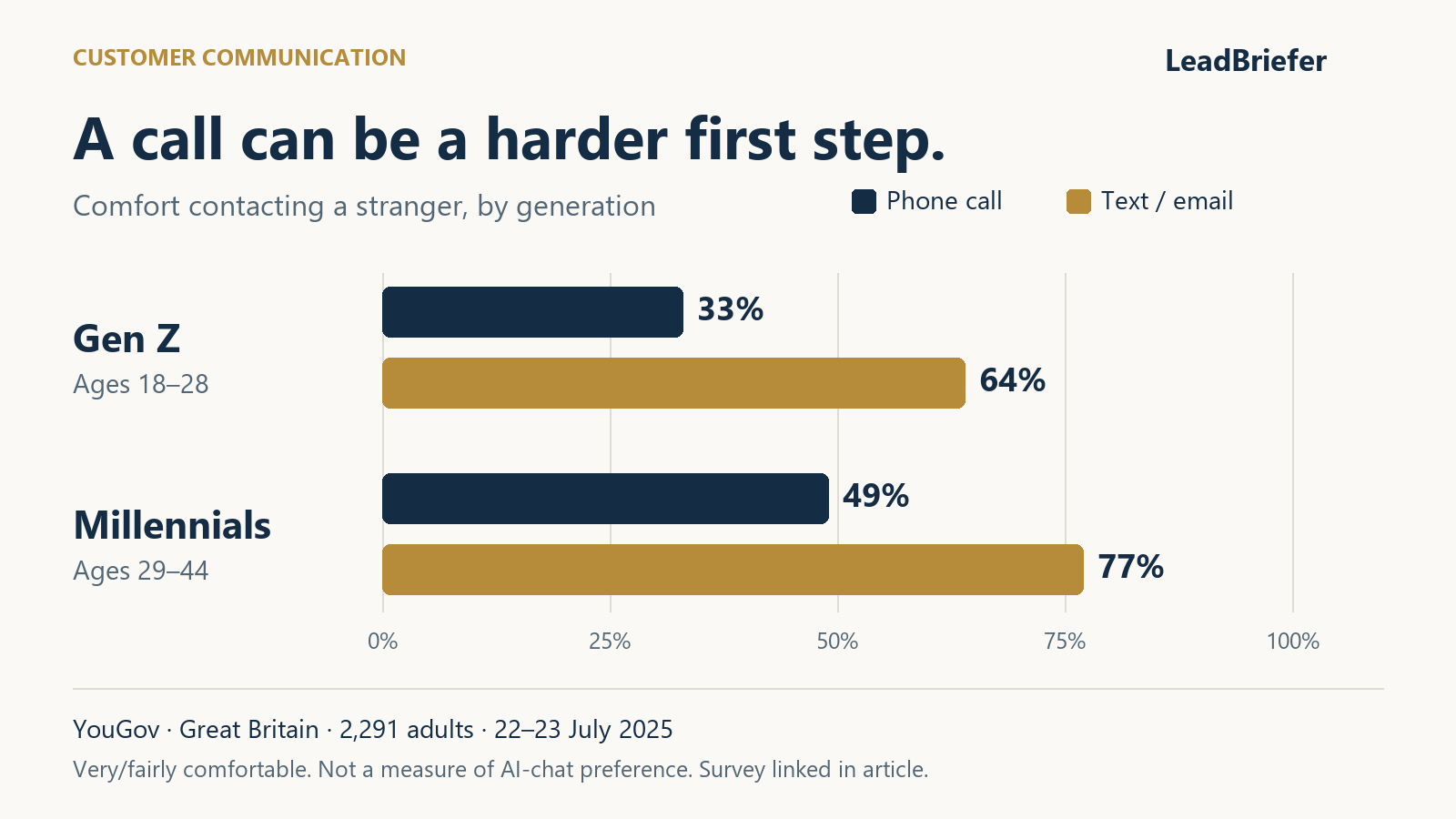
In a YouGov survey of 2,291 adults in Great Britain, conducted July 22–23, 2025, 65% of Gen Z respondents felt uncomfortable making a phone call to a stranger. Among millennials, the figure was 47%.
The chart above shows the other side of that comparison:
- Gen Z: 33% felt comfortable calling a stranger; 64% felt comfortable sending a text or email.
- Millennials: 49% felt comfortable calling a stranger; 77% felt comfortable sending a text or email.
The survey defined Gen Z as ages 18–28 and millennials as ages 29–44 at the time of fieldwork. “Comfortable” includes very and fairly comfortable responses.
This measures comfort with contacting a stranger. It does not establish a preference for AI chat or predict sales. Our practical takeaway is that a typed first step deserves a place alongside your phone number.
An unanswered call is a broader challenge, too
There is also a difference between being interested in a business and being willing to answer an unfamiliar number.
Pew Research Center’s July 2020 survey of 10,211 U.S. adults found that about eight in ten generally did not answer cellphone calls from unknown numbers.
That finding covers all adults and unknown numbers in 2020. Younger adults in that survey were actually more likely to pick up than older adults, so missed calls are a broader issue than a generational preference.
For a business owner, the useful reminder is simple: a callback can be missed even when a person has a real request. Offering another way to start can help you avoid making a phone connection the only route forward.
Give customers an easy first question
Consider someone looking for bookkeeping help. They may know that their records are behind without knowing how to describe the scope of the work.
An illustrative first exchange could look like this:
Customer: I’m behind on my bookkeeping. Can you help?
Assistant: How many months do you need help catching up with?
Customer: About three months. I’m not sure what else you need to know.
Assistant: What kind of business do you run?
The conversation gives the customer a manageable question to answer. They do not need to prepare a complete explanation before getting started.
That is where a useful chat can earn its place: helping someone turn an uncertain opening message into a clearer request.
Why chat can fit the way a customer wants to begin
A typed conversation gives people room to put their thoughts into words. They can explain the job, add context, and ask their own questions without first arranging a phone conversation.
For a service business, that creates an opportunity to learn what the customer actually needs while the inquiry is still taking shape.
The experience still needs to be helpful. Relevant questions, clear answers, and an understandable next step matter more than simply putting a chat box on a page.
We explored that distinction in Keep Customers Engaged From the First Question, which compares a conventional form with an interactive conversation.
Where LeadBriefer fits
LeadBriefer is being built to give customers a natural way to start that conversation through your business link.
You provide information about your services, pricing, intake requirements, and the details needed to prepare a quote. Your assistant uses that information to choose relevant questions, answer the customer, and gather the details of their request.
Those details support the next step: preparing a draft quote using your pricing, ready for you to review, adjust, and approve.
The intended benefit is useful on both sides. A customer who would rather type has a way to get started. You can pick up the inquiry with a clearer understanding of the work they are asking about.
Let the customer start comfortably, then take the next step
A phone conversation still has a place. A complex request, a sensitive question, or a job that needs a visit may call for your personal attention. Some customers will prefer speaking with you from the beginning.
Offering chat gives people another entrance to your business. A customer can begin with a message, clarify the basics, and have a more informed conversation with you when it is needed.
Make it easy to say the first hello. Join the LeadBriefer early access list for updates on when you can offer your customers a natural chat with your business assistant.